For CEOs, seniors & founders of agencies, IT & tech companies
How to generate $1M in revenue in 180 days
And how to run the entire commercial funnel, from first signal in the market to signed deal.
I am going to show you the exact framework we used to help Amsterdam Standard close $1M in revenue in 180 days.
The same commercial engine we build, run and optimize for agencies, IT and tech companies like yours.
By the end of this page you will understand the most common commercial leaks, how the four layers address them, and what we would need to inspect together to diagnose yours.
Including the strategy behind closing $1M in new contracted revenue within 180 days, while removing the reliance on you to still close most deals.
Finally getting a clear picture of who you are for, and how to sell them cold.
Removing the dependency on network and referrals.
And building an offer that gets your foot in the door, so you can work with long-term clients.
This is the same system behind more than $6M in client sales and 800 booked qualified opportunities for our partners in the last twelve months.
This is you. Right now.
You built a real company.
Good product. Happy clients. Steady growth most years.
You are not standing still either. New markets. AI in the roadmap. A sharper product.
But here is the truth underneath it.
Sales still runs through you.
The big deals close because you close them.
Your network and your referrals filled the pipeline for years. Now it is thinning.
And if you are honest, it never gave you a real conversion number.
People said yes because they knew you. Not because a system worked.
You lack predictability because nobody owns the commercial system end to end.
And there is money you can already sense but cannot reach. Leads in the CRM. Accounts you have never once contacted.
The problem is not you.
The problem is that nobody owns the machine that is supposed to make growth predictable.
It was never anyone's job. So it never got built.
Our partners below had the same issue. Until they applied Full Funnel Control.
Amsterdam Standard: a $1M deal on a 4 year contract, and a 20x ROI within 12 months
Envative: from cold emails to 10x better qualified leads
Small Giants: from founder-led sales to a funnel they own
You have already tried to fix this
You hired sales people. More than once. Without consistent success.
Or you went looking for a real hunter and could not find one. The good ones were already locked up somewhere else.
You bought tools and lists.
Now you own a CRM that is really a filing cabinet with a login.
You hired a lead-gen agency.
They got paid for activity they could bill. So that is what they optimized. The follow-up, the nurture and the close came straight back to you.
You leaned harder on referrals.
No control. No insight. Lower margins. And the well runs dry.
Now look at what all of them share.
Everyone owned a piece of the funnel. Nobody owned the commercial outcome.
The offer, the targeting, the outbound, the follow-up and the close all sat in different hands.
So your deals fell through the seams.
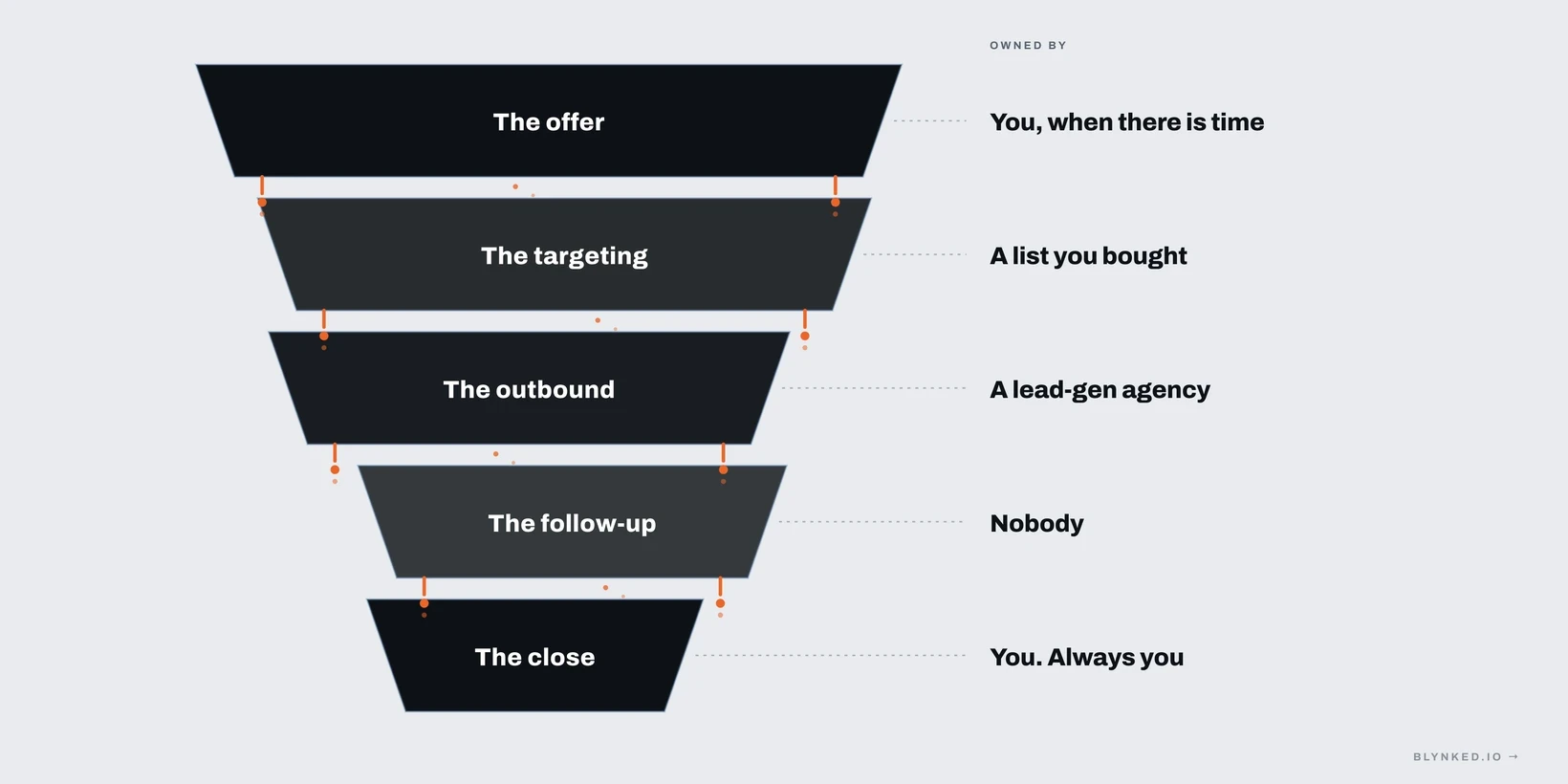
And none of them was accountable for the one number that matters.
Revenue.
Here is the part they all ignore.
At any moment, at best about 1 in 20 companies in your market is ready to buy right now. The LinkedIn B2B Institute calls it the 95-5 rule.
Everybody fights over the 5 percent. They burn out their list.
The 95 percent, the not-yets, get ignored.
And that is exactly where next year's revenue is hiding.
It goes to whoever follows up when the timing finally changes.
The fix is not outsourcing another piece of the funnel.
It is one system that owns the whole funnel.
Full Funnel Control
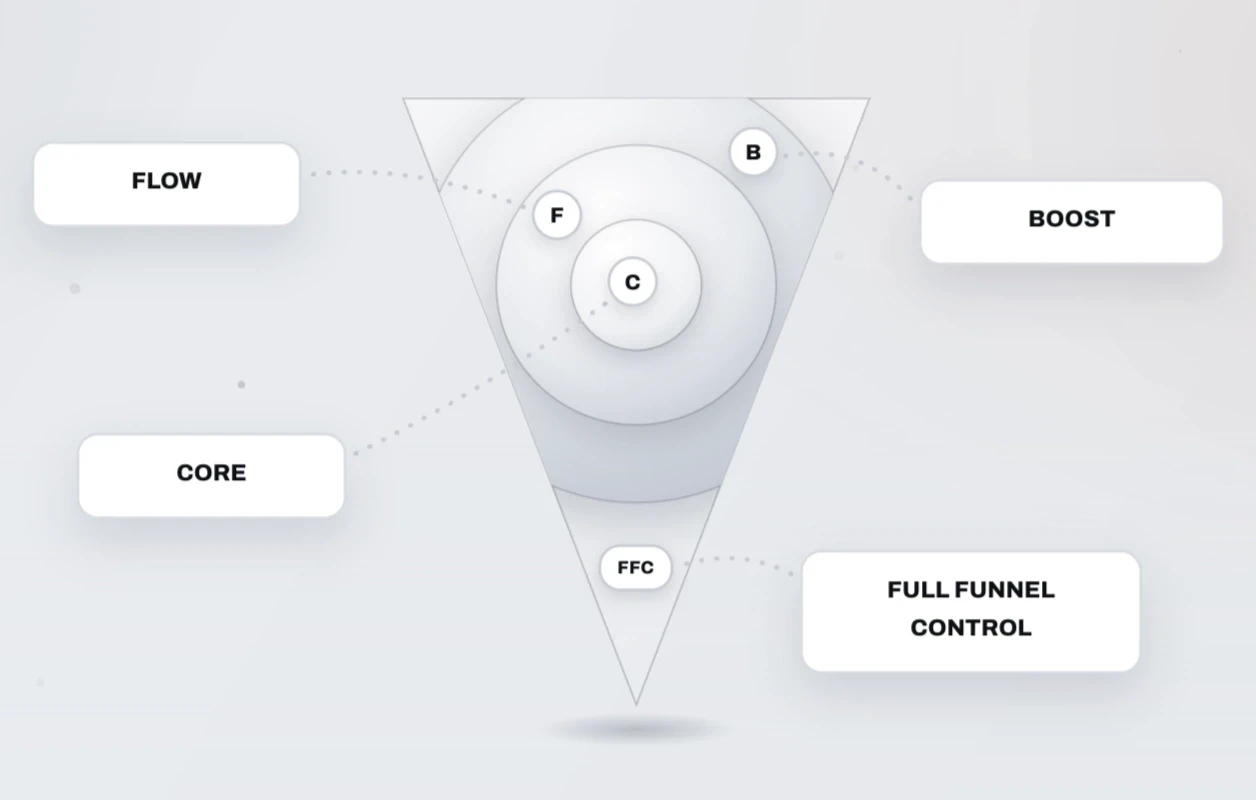
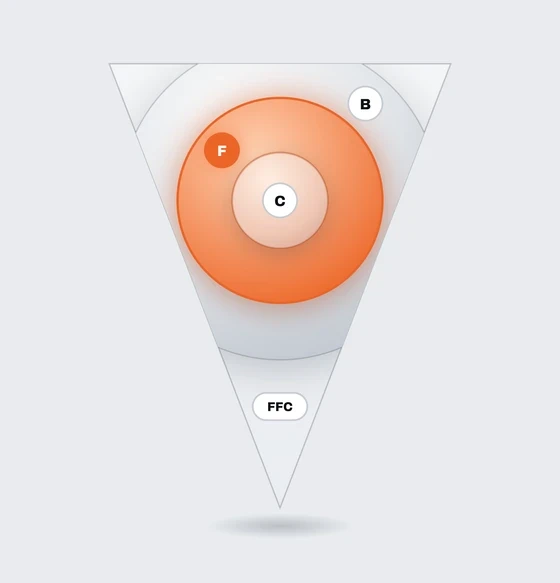
Four layers. Core, Flow, Boost, and the close.
Core transfers founder-held market knowledge into a specific ICP, offer and buyer language.
Flow turns that into targeting, outreach, routing and CRM visibility.
Boost and Full Funnel Control add human ownership from response through discovery, follow-up and the agreed signed-deal path.
Each layer can be an entry point, but the commercial gap is not closed until ownership stays connected all the way through.
So you start where you are today. And you climb.
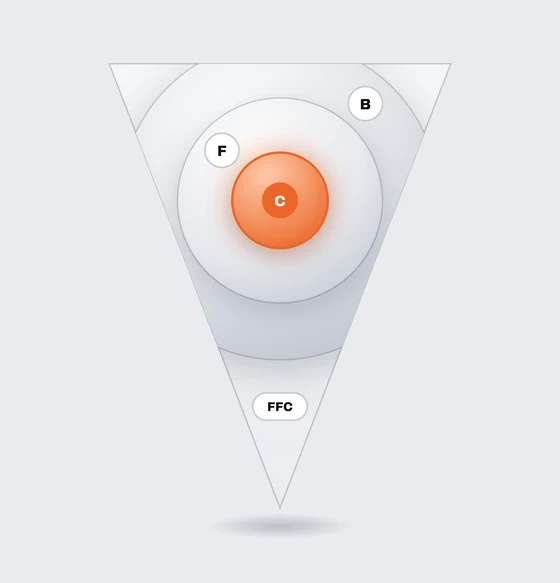
Layer 1 - Core
Transfers founder-held market knowledge into a specific ICP, offer and buyer language.
Here is what we find every time.
The founder says, proudly, "we can do anything."
That is the exact thing killing the growth.
Because doing anything for everybody means you are nothing for no-one.
A cold buyer gives your message three seconds. "We can build anything" gives them nothing to say yes to.
That is not a volume problem. You cannot out-send it. It is an offer problem.
And you might say you have a niche and an offer. Or that you have already been building on that.
We get it. Narrowing down your product or service might feel like it.
But let's be honest. Even companies with a clear niche often struggle to translate that positioning into a message that works in outbound.
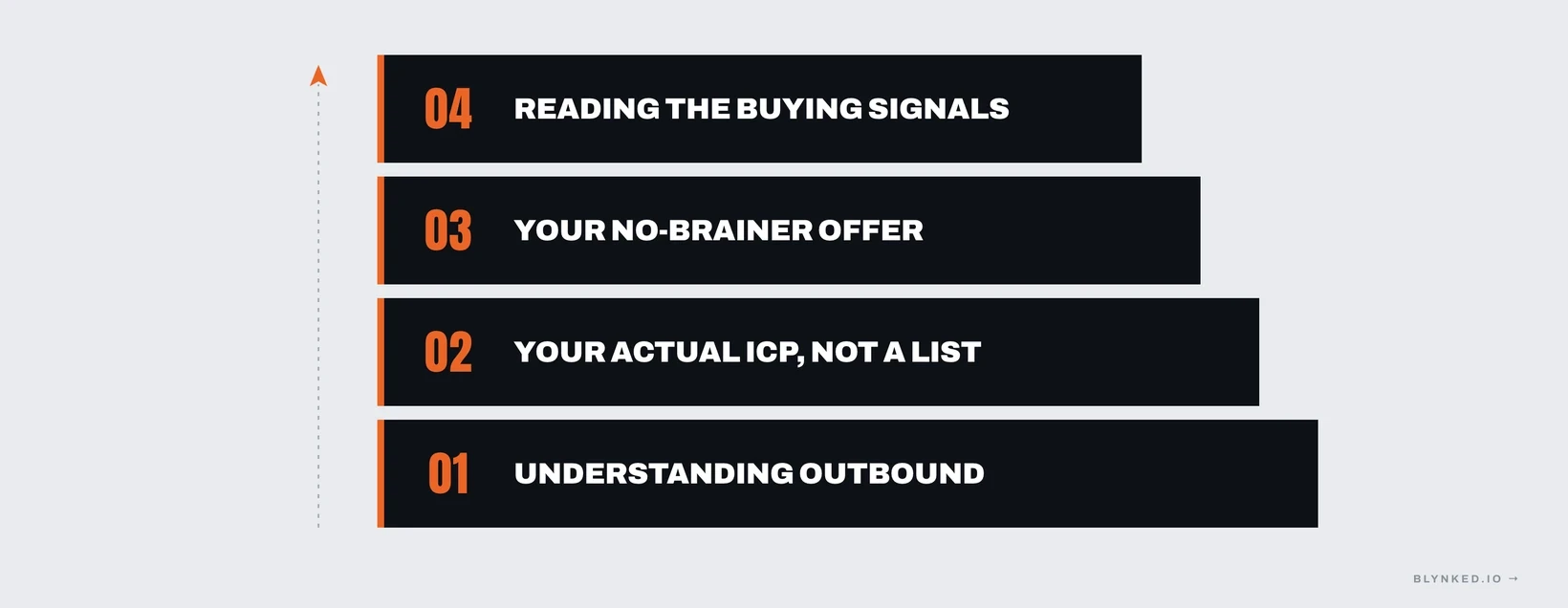
So in order to fix that, we are going to fix four things.
Understanding outbound. Clarifying your actual ICP, not just creating a list. Building your no-brainer offer. And reading the buying signals.
Understanding outbound
To sell the right offer to the right people, we need to clarify what outbound is, and how it differs from inbound.
Especially since most people apply an inbound mindset to an outbound audience.
And this fundamentally does not work. It is why the offers you tried to create always failed.
So before moving into the next step, you and your team need to know the difference.
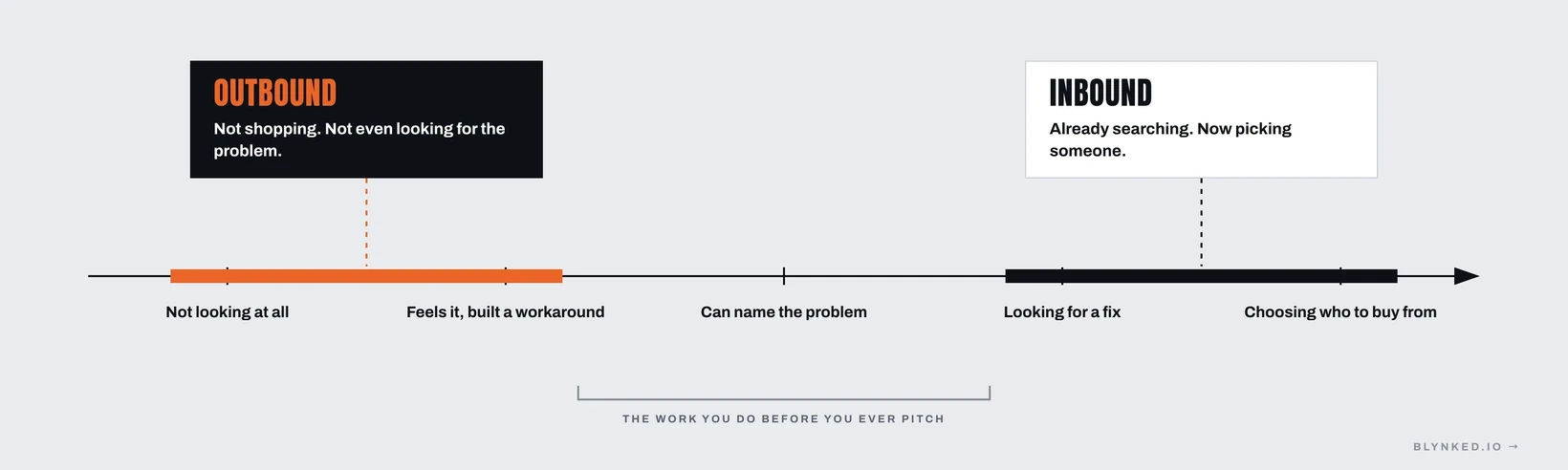
Inbound prospects - your network, referrals, website opt-ins - are already looking for a solution. They have gone through the whole decision-making process internally and know what they are looking for. You do not have to convince them what they need. You just have to sell them on it.
An outbound audience is a cold audience. They do not know you yet. And more often than not, they do not yet know they have a problem either.
Maybe they cannot pinpoint it. Maybe they feel it, but it does not hurt enough to act on. Maybe they built a workaround and stopped noticing it. Or they are simply not shopping at all, busy with something else entirely.
An inbound buyer is already looking for the fix. A cold one is not even looking for the problem.
So it is on you to make them feel that problem first, before you ever try to sell the solution.
During our partnership we take you and your team through this first, across a few modules.
Because if they do not understand what we do and how we do it, we will never get the right feedback to work toward the end result you need.
Clarifying your actual ICP, not just creating a list
"More than €5M in revenue, minimum 20 employees and located in Europe with outdated technology" is not an ICP.
It is a list.
A real ICP goes deeper. It outlines what they need, what they avoid, what they want, why they do not fix it, and what fixing it is worth to them.
So once you and your team understand the core difference between inbound and outbound, we can work on creating the actual ICP.
We do that by defining who you are actually after, and then mapping who gets what attention.
Defining who you are actually after
Before you can decide who gets what attention, you have to know who you are truly after. And that is not something you can invent from behind your desk.
Most ICPs are guesses. A founder's gut, a few assumptions, last year's best clients frozen in time.
But the market does not care about your assumptions.
And right now, with AI moving everything, what was true last year may not be true today.
So we do not guess.
We build your ICP from evidence, and from what the market is actually asking for now.
We look hard at two groups. Your best clients, the ones you would happily clone. And your lost deals, the ones that got away.
In both we look for the same things.
What did they really want? What were they afraid of? Why had they not fixed it already? And what was fixing it worth to them, in real money?
The patterns that come out of that are your real ICP. Not a size and a sector, but a picture of who buys, and why.
Then we narrow. Hard.
Because when you try to speak to everyone, you speak to no one.
Mapping who gets what attention
Time is your scarcest resource. So the last job in Core is making sure you never waste it on the wrong people.
Two questions decide that.
How much is an account worth, and who inside it actually matters.
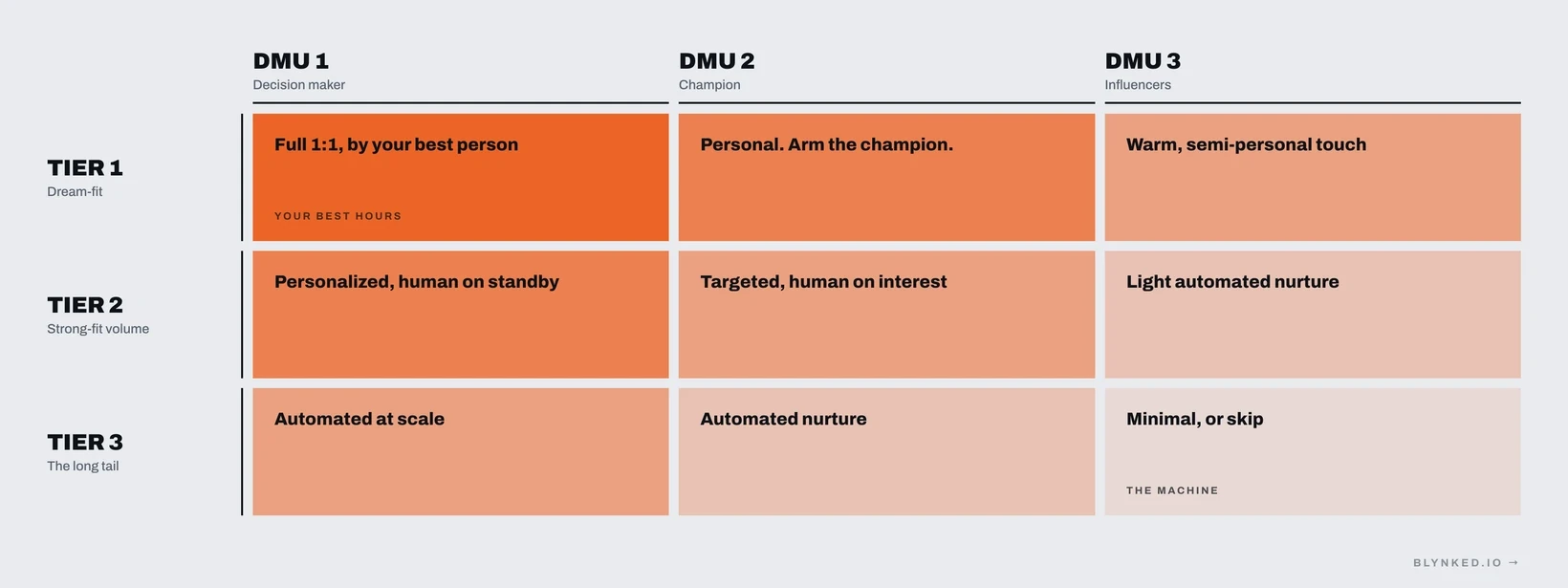
Start with the accounts. We rank your whole market against the ICP into three tiers.
Tier 1 is your dream-fit accounts. A perfect match, high value, the ones that could change your year. Worth a real person.
Tier 2 is strong-fit volume. A good match, worth serious effort, mostly through campaigns with proper follow-up.
Tier 3 is the long tail. A possible fit, lower value. Still worth reaching, but through automation, not your best hours.
Do the same with the DMU.
DMU 1 is the decision maker. The person who owns the outcome and can actually say yes. Your primary target.
DMU 2 is the champion. The person who feels the pain, wants it solved, and will carry your case to the decision maker. Your ally on the inside.
DMU 3 are the influencers. The people the decision maker trusts before making the call: the technical lead, the future users, the advisor whose opinion tips it.
It is obvious once you see it.
Tier 1 and DMU 1 should never get the same treatment as Tier 3 and DMU 3.
Your best people, in person, go top-left.
The machine handles the bottom-right.
Everything in between gets the right mix of both.
Building your no-brainer offer
Now we know the difference between inbound and outbound. And we know who to target.
But with what?
Building the offer is the most important part.
Because sending more of a broken message just breaks it faster.
And even aiming at the right buying signals with a weak offer still leads to nothing.
Businesses buy end results.
They do not care how you solve their problem, as long as you solve it.
So the first skill is learning to say your value as an outcome, not as a deliverable.
Your best raw material for that is your own client results. Everything you have delivered can be tied to revenue gained or hours saved, and that is what people actually buy.
By talking to your current clients and reframing what you did, "we helped X build a custom ERP tailored to their needs, saving them time" becomes "we helped X free up 10 FTE of manual work, worth about €500k a year, in 8 months."
"We manage X's IT environment with 24/7 support" becomes "we cut X's downtime by 90 percent, saving roughly €200k a year in lost production."
"We built X a custom customer portal" becomes "we removed X's manual order entry, freeing 3 people and cutting order errors to near zero."
And "we migrated X to the cloud" becomes "we cut X's infrastructure bill by 40 percent and made new releases five times faster."
Both sides solved the exact same problem. One of them just says it as a result.
Which one would you reply to?
Once you can say your value as an outcome, you shape it into two offers. They do different jobs.
Your no-brainer offer
This is the big one. The offer built to stop someone mid-scroll and make saying no feel like the wrong call.
It takes your boldest outcome and puts real risk reversal behind it, so the buyer has almost nothing to lose by saying yes.
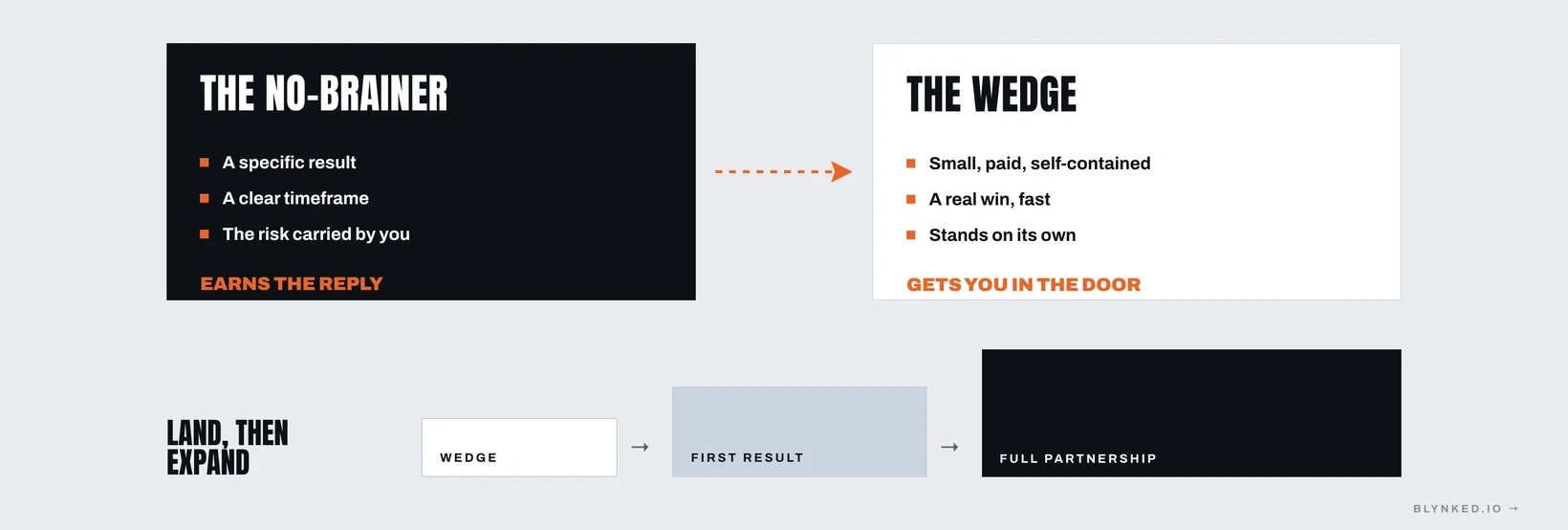
The shape is always the same. A specific result, a clear timeframe, and the risk carried by you, not them.
"A working prototype in 3 weeks, or you do not pay." "We cut your cloud bill by 30% in 90 days, or the work is free." "Your top 3 recurring support issues gone in 60 days, or the month is on us."
Its job is not to close the deal on the spot. Its job is to trigger. To earn the reply, the click, the call.
Your wedge offer
Not everyone is ready to bet on the big promise straight away. Especially buyers who have been burned before.
So you also need a smaller way in. A wedge. A lower-risk first step that delivers a real, concrete win fast, and opens the door to the rest.
It is usually a small, paid, self-contained piece of the bigger picture. A paid audit that hands them a clear plan. A single automation built before the full platform. A two week pilot that proves the thing works.
It stands on its own, it proves you can deliver, and for most clients it becomes the first step of a much bigger partnership.
Land, then expand. The wedge gets you in the door. The results keep you there.
One offer to pull people in. One to give the careful ones an easy place to start. You want both.
Reading the buying signals
Now you know who to go after, and what to sell them.
But you do not know who is ready to buy yet.
That is a different question, and it matters. Only about 1 in 20 companies is in-market at any moment.
Signals tell us where and when to look.
Context tells us why it matters and how to approach it.
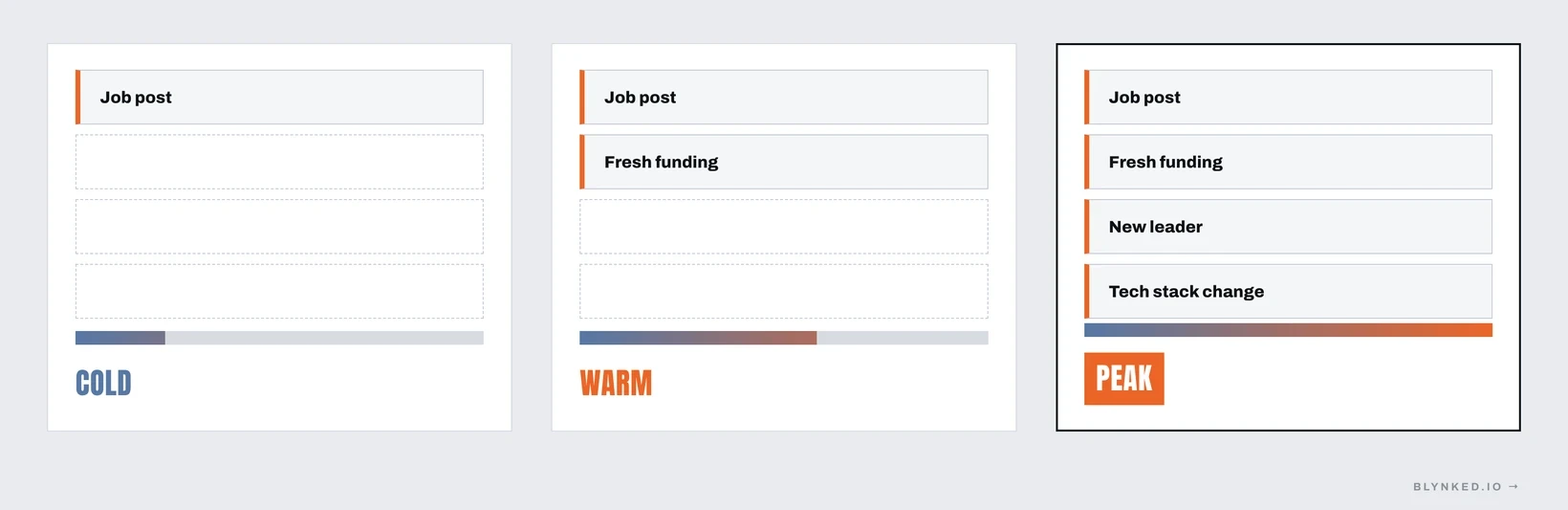
A job post for the exact role that owns your problem. New funding. A new leader. A change in their tech.
Alone, each is a whisper. Stacked, they are a shout.
So we identify, upfront, which signals matter for your ICP and what each one means.
Each of these stacks up using a scoring system. The higher the score, the higher the intent.
That becomes a simple read on how warm an account is and how fast to move.
Defining the signals happens here. Tracking them and acting on them is what Flow and Boost do next.
Get Core right and your entire team finally knows what a good deal looks like.
You do not have to bet the whole thing on day one either. Core stands on its own as a paid first step. Low risk. Fast to prove. See the engine work before you scale it.
Layer 2 - Flow
Turning Core into targeting, outreach, routing and CRM visibility.
Now you know who you are for, and what you sell.
You are still blind to one thing. Who wants it right now.
Most companies guess. One message. The whole list. Same day.
To be honest, that can work. But only with a great offer behind it.
And most companies do not have one, which is why blasting the list, or chasing signals without a reason to buy, never delivers.
You fixed that in Core. So now the aim is finally worth taking.
That is what Flow is. The system that aims before you pull the trigger, and then runs the whole outbound motion for you, at scale.
It starts with a lead scoring model.
We set up the engine to detect the buying signals you defined in Core. The job post for the role that owns your problem. The new funding. The new leader.
The system scores them automatically into one intent score, so the moment an account heats up, you know instantly.
A pricing page visit is worth 30 points, because they are actively evaluating. Three visits in a week is worth 50, because they are seriously evaluating.
A job post for the role that owns your problem adds 25 - they are building the need internally. Fresh funding adds 20, the budget just appeared. A new leader in the relevant function adds 15, a new mandate and open to change. Three opened emails adds 10. And thirty days of silence takes 10 back off.
Then the score turns into an action, so it never just sits there as a number.
Above 70 an account is hot. Handed to a person immediately. Called today.
Between 40 and 69 it is warm. A personalized sequence, with a human jumping in on any reply.
Between 15 and 39 it is lukewarm. Automated nurture, keep watching.
Under 15 it is cold. It stays in the system, and nothing happens until a signal fires.
So three pricing-page visits this week is a reason to move today, not a newsletter next month.
Then the outbound runs itself.
Automation creates focus. People create commercial progress.
The system monitors, scores and routes. People handle replies, calls, qualification and follow-up.
Automated sending from warmed inboxes, so you land in the inbox, not spam.
Every reply and every new prospect flows straight into the CRM, scored and ready, with nothing managed by hand.
There is real infrastructure under all of this. The inboxes, the domains, the CRM, the automations.
You do not need to understand any of it.
That is the whole point of a system. It runs, it scales, and it does not forget.
This is the opposite of the blast you get 20 times a day and delete on sight.
And let's be honest. There is a reason you are reading this.
Not because you found it by accident. But because we run this exact system for ourselves. And it works.

Layer 3 - Boost
Adding human ownership from response through discovery.
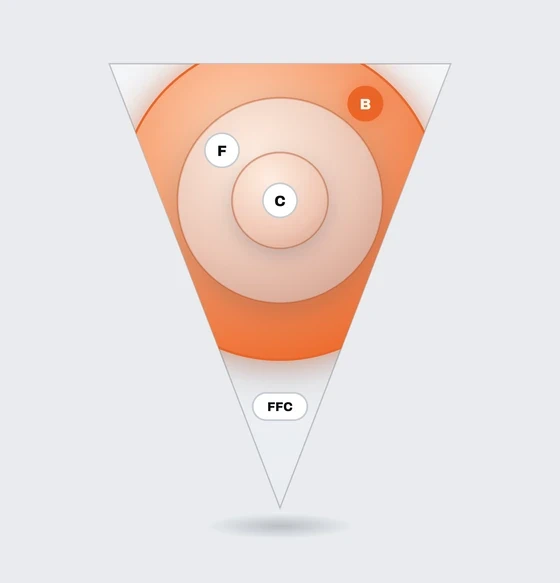
This is where it breaks for companies that got the first two layers right, but do not have the right people in place to handle what comes after the system.
Because in the end, people still buy from people.
The engine produces replies. And then the replies just sit there.
A reply rots. The hand raised at 9am is cold by lunch.
So the first job is speed. Warm replies called back in minutes, by phone, while the interest is still alive.
Not clever. Just faster than everyone else. And not some strange AI bot, just real people trying to help.
But speed on its own is only half of it. Move fast on everything, and the calendar fills up with the wrong conversations.
So Boost is really about a mix of two things. Efficiency and effectiveness.
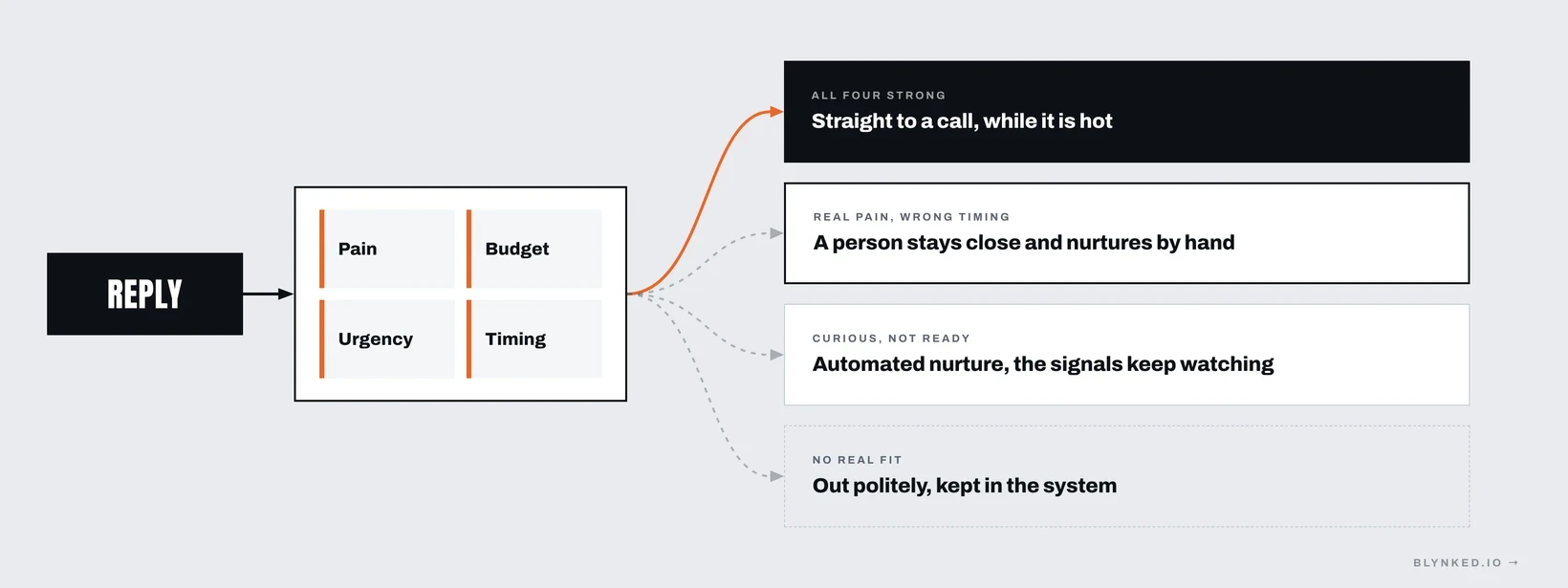
Efficiency is going deep only where it is worth it. Every reply runs the same filter first. Pain, budget, urgency, timing. The score decides the route, so no one spends an hour on a lead that was never going to buy.
Pain, budget, urgency and timing all strong goes straight to a call, while it is hot.
Real pain, but the timing is off, gets a person who stays close and nurtures by hand.
Curious, not ready, goes into automated nurture while the signals keep watching.
And no real fit goes out politely, but stays in the system.
Effectiveness is getting the most out of the people doing the selling.
Their strength is the conversation, not the chasing.
So the system does the chasing, the scoring and the routing, and the hours go only where a human actually moves the deal.
And phone, email and LinkedIn work together, so you already feel familiar before you even call.
Then the part everyone throws away.
"No" almost always means "not now."
Every lost deal gets a reason. The reason sets the return route. And the signals pull it back the moment it moves.
That is how the 95 percent becomes next year's pipeline. Instead of a dead list.
And that is the effectiveness point again. No lead is wasted. The hot ones get a person, the not-yets get remembered, and every name in the system keeps its value.
Layer 4 - Full Funnel Control
Own the close and the revenue.
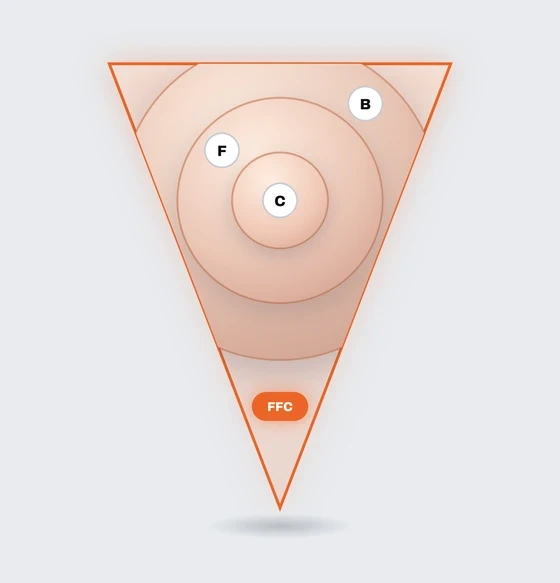
This is the part most outbound never reaches.
And the part where the opportunity gets turned into the only metric that actually matters.
Revenue.
Booking the meeting is only the beginning. The real commercial work starts afterwards.
Most agencies only book the meeting and make the rest your problem. Because the close is the part they cannot fake.
So it comes back to you. And sales stays stuck in one or two heads. Most likely yours.
A booked meeting is not a deal yet. It is a chance to lose one slowly.
And since we stripped down who we target, outlined what pains they have, created an offer that focuses on the outcome, and reached out based on the right buying intents, we can make it repeatable.
Without someone needing to know all the ins and outs. Because it is clear what you sell.
Discovery, the same way every time. The pain. Its cost in real money. Their budget. Their timing. How the decision actually gets made.
By the end of call one, you know if it is a deal.
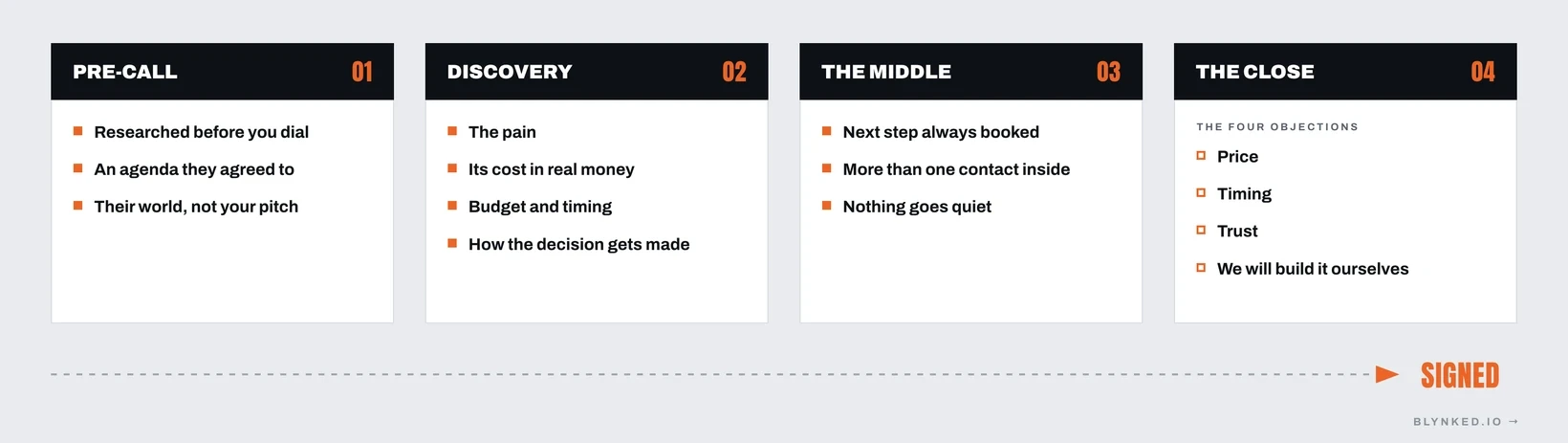
Then you survive the middle. Long deals go quiet. Never leave a call without the next step booked.
Then you close. And you prepare for the four objections that hit every deal. Price. Timing. Trust. And "we will build it ourselves."
In the full version, we run all of this for you. Like an in-house team you never had to hire.
In the lighter version, we make your team great at it.
Either way, your pipeline stops dying the moment it gets interesting. And it stops depending on you.
The honest part
This does not work in every case, and it would be dishonest to pretend otherwise.
The companies it works for can deliver when the pipeline fills, so new demand turns into revenue instead of chaos.
Their deals are worth at least thirty thousand dollars, so the math makes sense.
They make a real product that clients are happy with.
And they are willing to drop the belief that they already have it all figured out.
Index and Amsterdam Standard had all of that when we started. If you recognize yourself in it too, this is for you. If you do not, we will tell you that on the call.